
Many parents of picky eaters wonder if their child needs extra vitamins or supplements. This is a very valid concern, and most of the time the answer is YES! If you’re looking for more insight as to whether your child needs supplements and how to find the best vitamins for picky eaters, keep reading…

Does My Picky Eater Need A Vitamin Supplement?
All children need an ongoing variety of vitamins and minerals to support healthy growth and brain development. As a dietitian, my goal for most children is a “food first” approach, but I find that even healthy children who eat a varied diet can have a hard time getting enough nutrients like vitamin D and omega-3s through their diet. With that in mind, children with limited diets, especially those who cut out entire food groups will need extra supplementation. Picky eaters who struggle with weight gain and digestive issues also tend to have an increased need for supplements.
Helping Your Selective Eater outlines the differences between various types of picky eaters and describes when to be concerned. Most children with ARFID, PFD and chronic picky eating will need a variety of ongoing supplementation. Children who are mildly picky or short-term (<2 weeks) picky eaters may be ok without taking regular vitamins, but it’s best to talk to a registered dietitian if you’re unsure.
In some cases supplementation can be temporary while you work to expand your child’s diet. However some picky eaters have an ongoing increased need for certain nutrients and may need to add supplements long term.
What Vitamins And Minerals Do Picky Eaters Need?
Kids that cut out entire food groups or rotate through the same few foods and brands can develop nutrient deficiencies. Sometimes these deficiencies are obvious, but more often than not symptoms are subtle or unnoticed. Unfortunately accurately testing for these deficiencies can be challenging as well. If your child isn’t regularly eating a “common food source” of any of these nutrients, chances are they’re at least mildly deficient.
Common Nutrient Deficiencies In Picky Eaters
| Nutrient | Common Food Sources | Signs of Low Intake/Deficiency |
| Potassium | dried apricots, raisins, baked potato, orange juice, bananas, coconut water, dairy | fatigue, heart palpitations, insulin resistance, muscle spasms, poor bone health, sleep disturbances |
| Vitamin A | dairy, eggs, fish, organ meat, leafy greens, orange and yellow fruits and vegetables | night blindness, white spots on eyes, lung disease / pneumonia, dry skin, poor immune function |
| Vitamin C | citrus fruits, tomatoes, kiwi, bell peppers, strawberries, broccoli | fatigue, inflamed gums, skin spots, loose teeth, poor skin healing |
| Vitamin D | fatty fish, liver, egg yolks, mushrooms (exposed to UV light), fortified dairy | fatigue, rickets, bone/teeth demineralization/cavities, failure to thrive, developmental delay |
| Vitamin E | nuts, seeds, nut/seed butters, oils, spinach, broccoli, kiwi | neuropathy, poor immune function, muscle weakness, retinopathy |
| Vitamin K | dark leafy greens, broccoli, edamame, pumpkin | bleeding/hemorrhage, weak bones |
| B Vitamins (folate, B6, B12) | liver, meat, fish, poultry, dairy, green vegetables, fortified grains | fatigue, learning delays, scaling lips, swollen tongue, poor immune function, pale skin |
| Choline | liver, eggs, beef, chicken, fish, baked potato, dairy | fatigue, fatty liver disease, learning delays, memory problems |
| Calcium | dairy products, fortified dairy alternatives, canned salmon (with bones), dark leafy greens | poor bone health (rickets, osteomalacia), tingling in hands/feet, weight gain |
| Iodine | seaweed, seafood, eggs, iodized salt, some dairy | impaired thyroid function and brain development |
| Iron | seafood (oysters), liver, beans, lentils, spinach, meat, poultry, fortified grains | difficulty concentrating, fatigue, learning delays, pale skin, psychomotor delays, sleep disturbances, weakness |
| Magnesium | nuts/seeds (pumpkin, chia), beans, spinach, baked potatoes | fatigue, migraines, muscle cramps, poor appetite, poor bone health, sleep disturbances |
| Zinc | seafood (oysters), meat, dairy, eggs, beans, lentils, nuts/seeds | dermatitis, diarrhea, fatigue, hair loss, learning delays, taste and smell changes, poor appetite |
| Copper | seafood (oysters), liver, nuts, seeds, baked potato, avocado, dark chocolate | impaired brain development, anemia, reduced skin pigmentation, abnormal cholesterol levels |
| Essential Fatty Acids | fatty fish, flaxseed, walnuts, chia seeds, grass fed beef/eggs | impaired mood/brain development, inattention, dry itchy skin, dry hair, hair loss |
As you can see, many of these nutrients have important roles in your child’s growth and development. Aside from potassium, choline and essential fatty acids (omega-3’s), many multivitamins will contain all of those key nutrients. However, depending on your child’s specific diet and symptoms, they may need additional supplements on the side like calcium, vitamin D, iron or magnesium. This article focuses specifically on multivitamins, but a registered dietitian can help you determine if your child needs any “add-ons.”
How To Choose Vitamins for Picky Eaters
Since chronic selective eating can lead to nutrient deficiencies, most picky eaters will benefit from a high quality multivitamin to support growth and brain health. There is no one-size-fits-all vitamin for selective eaters. This depends on their age, nutrient gaps and tolerated form.
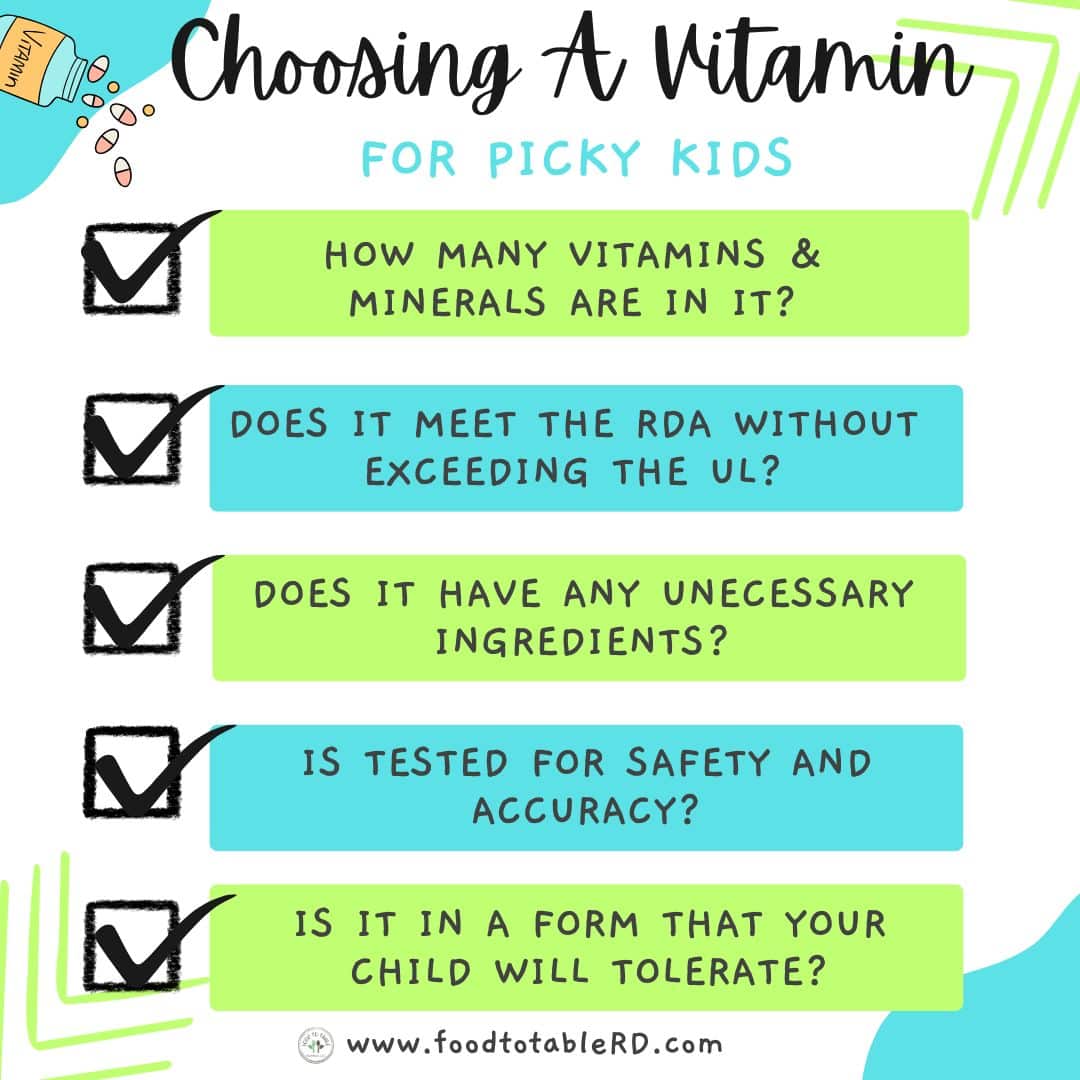
When evaluating vitamins for picky eaters, it’s important to look at:
1. Total number of vitamins and minerals
There’s no set right amount to aim for, but typically the higher the number, the more well-rounded it is. Gummies and common retail brands tend to have a lower count than many specialty brands.
2. Dosage compared to the Recommended Dietary Allowance (RDA) and the Upper Limit (UL)
Most children do best with dosages that fall between the RDA and UL. Dosages below the RDA may not be enough to replenish nutrients. But dosages higher than the UL can risk unwanted side effects and should only be used under the supervision of a health professional. Keep in mind that the suggested dosage on the package is not always safe or necessary. A dietitian can help you determine the best dosage for your child.
3. Added ingredients
As with food, I always recommend reading the ingredients list of supplement labels. Avoid artificial flavors, colors and additives. If your child has any allergies, check the label to make sure it’s allergen-free. I personally recommend avoiding sugar-sweetened vitamins, especially gummies as these are more likely to stick to the teeth and cause cavities. Sugar can come in many forms including cane sugar, honey and rice syrup to name a few. For chewable brands, opt for natural, non-sugar sweeteners like xylitol, stevia or monk fruit.
4. Sourcing and Safety Testing
It’s always important to know that your child’s vitamin is safe. You want to make sure that it contains what it says it contains in the right amount and without any contaminants. Buying Third-Party Tested supplements from a reputable supplier is probably the easiest way to ensure this. Third-Party testing can be expensive, so if you find a product that isn’t tested, you can call to ask the company for a Certificate of Analysis. Purchasing through a healthcare provider from a supplement dispensary can also help to ensure product safety.
5. Acceptable Form
Lastly, but definitely not least, you will want to make sure that the vitamin supplement is in a form that your child will tolerate. The most common forms of kid’s vitamins are liquid, powder, gummy, chewable tablet or swallowable tablet/capsule. Your choice will partly depend on your child’s age and developmental stage. There are pros and cons to each type, and picky eaters will keep you guessing! I find that the most nutritionally well-rounded options tend to be powders, chewable or swallowable tablets or capsules.
Getting Your Picky Eater To Take A Vitamin
As mentioned above, choosing the right form is one key to getting your child to accept a vitamin. But sometimes age, sensory challenges and supplement overwhelm can make it difficult for picky kids to accept vitamins. In these cases, the following tips and tricks can be helpful:
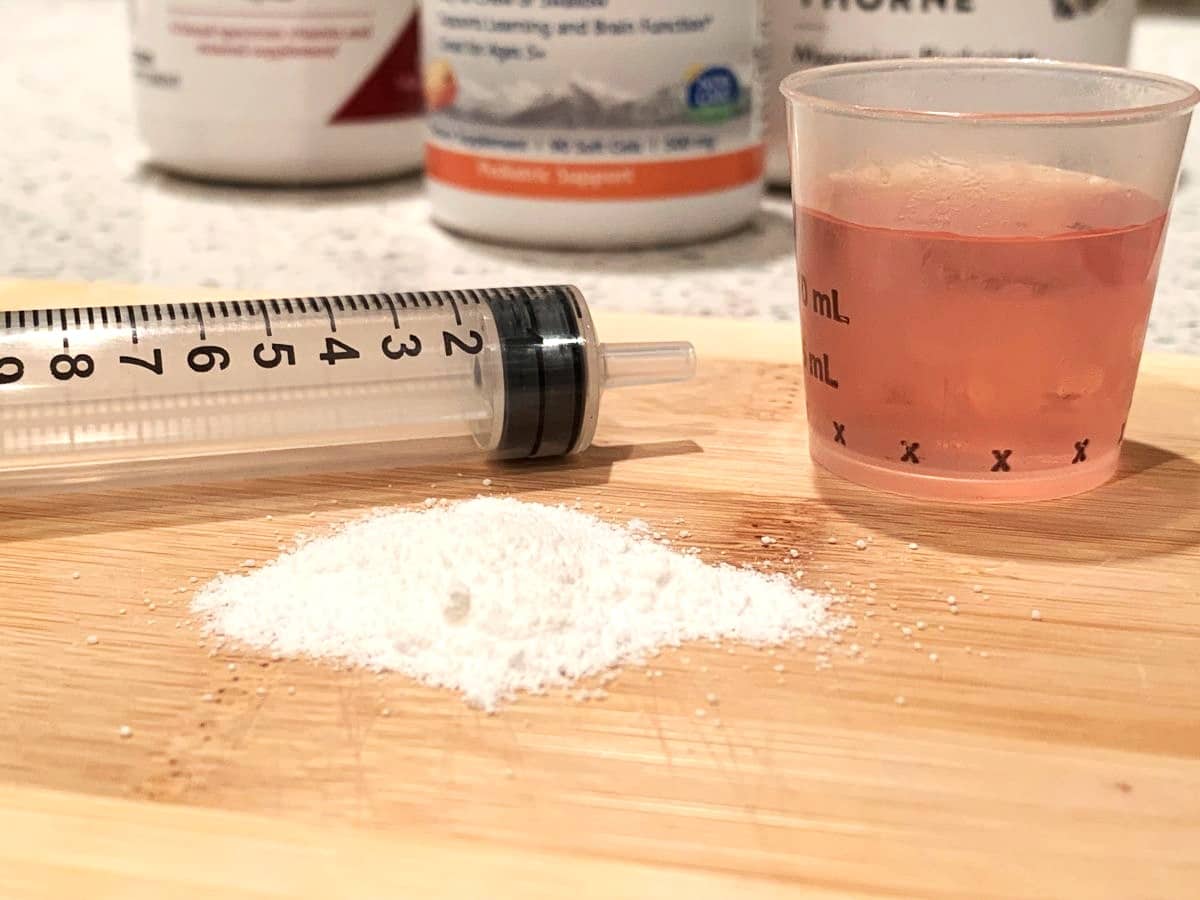
- Mix with a fun drink: Choose any form of vitamin (powder, liquid, crushed tablet or opened capsule) and mix with 1-4 oz drink (100% fruit juice, Olipop, nutrition shake, smoothie etc). Start with a small volume in case they don’t like it.
- Treat it like a medicine: Using the above method, mix with the smallest volume of water that still allows for blending. Use a medicine syringe to squirt the mixture towards the back of your child’s cheek (to prevent them from spitting it out).
- Mix it in a semi-solid food: Use the above method, but instead of mixing into liquid, mix into applesauce, yogurt or homemade pudding. Serve with toppings if needed!
- Wash it down: If your child is only slightly hesitant or doesn’t love the taste of the vitamin, simply keep a basic drink like water or milk nearby to help wash it down.
- Use a Pill Swallow Cup: This cup can be a great way to train your child to swallow capsules and is especially helpful for kids who need to take a lot of supplements.
- Reward System: Because of how important restoring lost nutrients can be, implementing a reward chart or system for taking the vitamin can be useful. You can use small, non-food oriented rewards like sticker charts to help motivate your child.
Top 10 Brands of Vitamins for Picky Eaters
Now that we’ve covered who needs a vitamin, what to look for in a vitamin and how to get your child to take the vitamin, I’ve taken the guesswork out of your search and provided some of my top picks. Using the criteria above, I’ve spent hours scouring vitamin labels (and even sampling a few) for you and came up with the following top 10 (plus a few ties)…
Best Kid’s Liquid Vitamin (With Iron)
Animal Parade Gold Multivitamin Children’s Liquid
- 21 key nutrients
- 10 nutrients meet RDA
- Sweetened with xylitol
- Allergen free; dye-free
- Third-Party Tested
- Suggested Dosage: to avoid exceeding Upper Limits, limit to 1 tsp for 1-3 year olds and 2 tsp for 4-8 year olds
- Product Reviews: Some parents report that the vitamin is thick, has a strong flavor and that the overall volume is high. Parents suggest dividing the dose or mixing in another liquid like juice.
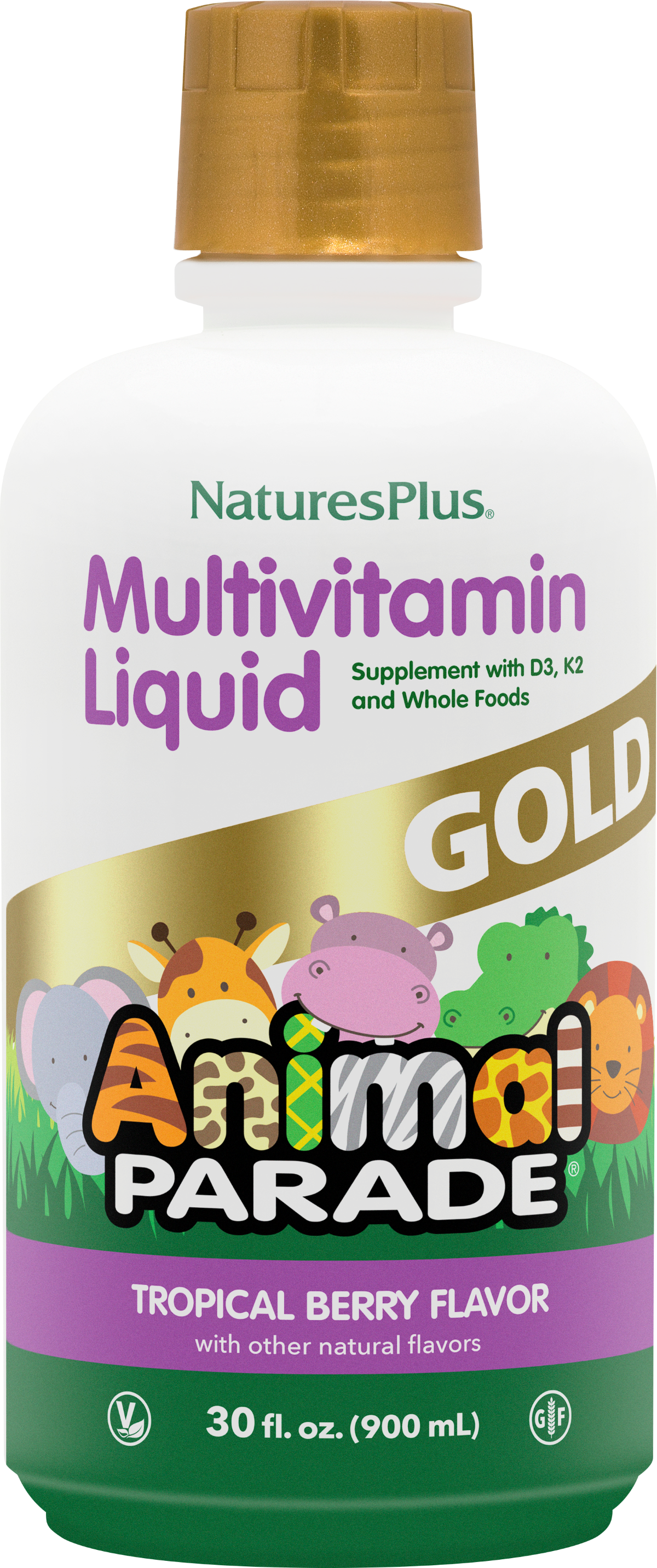
Photo by NaturesPlus
Best Kid’s Liquid Vitamin (No Iron)
Childlife Essentials Children’s Multi Vitamin & Mineral
- 20 key nutrients
- 14 nutrients meet RDA
- Sweetened with fructose: to reduce the risk of cavities, take with meal and rinse mouth with water and/or brush teeth after use
- Allergen free; dye-free
- Third-Party Tested
- Suggested Dosage: to avoid exceeding Upper Limits, limit to 2 tsp for 1-3 year olds and 3 tsp for 4-8 year olds
- Product Reviews: Some parents report that the vitamin has a strong flavor. Parents suggest mixing the vitamin in another liquid like juice.
Best Kid’s Powdered Vitamin (With Iron)
- 27 key nutrients
- 25 nutrients meet RDA
- Unsweetened
- Allergen free; dye-free, additive free
- Third-Party Tested
- Suggested Dosage: use recommended package dosage on age-appropriate product lines (2 scoops for NanoVM 1-3, 2 scoops NanoVM 4-8)
- Product Reviews: Some parents report that the product doesn’t dissolve well, adds a slight pink color and has a slightly bitter taste. Parents suggest dissolving the powder in 30 mL warm to hot water prior to mixing in other foods/liquids or mixing with salty/sour foods such as eggs, potatoes, soup, pasta sauce, salsa or milk.
Best Kid’s Powdered Vitamin (No Iron)
Garden of Life Kid’s Organic Multivitamin Powder
- 15 key nutrients
- 10+ nutrients meet RDA
- Unsweetened
- Organic, allergen free; dye-free
- Third-Party Tested
- Suggested Dosage: to avoid exceeding Upper Limits, limit to 2 tsp for 1-3 year olds and 3 tsp for 4-8 year olds
- Product Reviews: Some parents report that the product doesn’t dissolve well and has a strong flavor. Parents suggest dissolving in milk rather than juice or splitting the dosage into 2-3 servings per day.
- 15 key nutrients
- 10 nutrients meet RDA
- Sweetened with monk fruit
- Allergen free; dye-free
- Third-Party Tested
- Suggested Dosage: 1 packet
- Product Reviews: This product has a high percentage of 5 star reviews suggesting that it blends well in various foods and liquids and has a good taste and high acceptance.
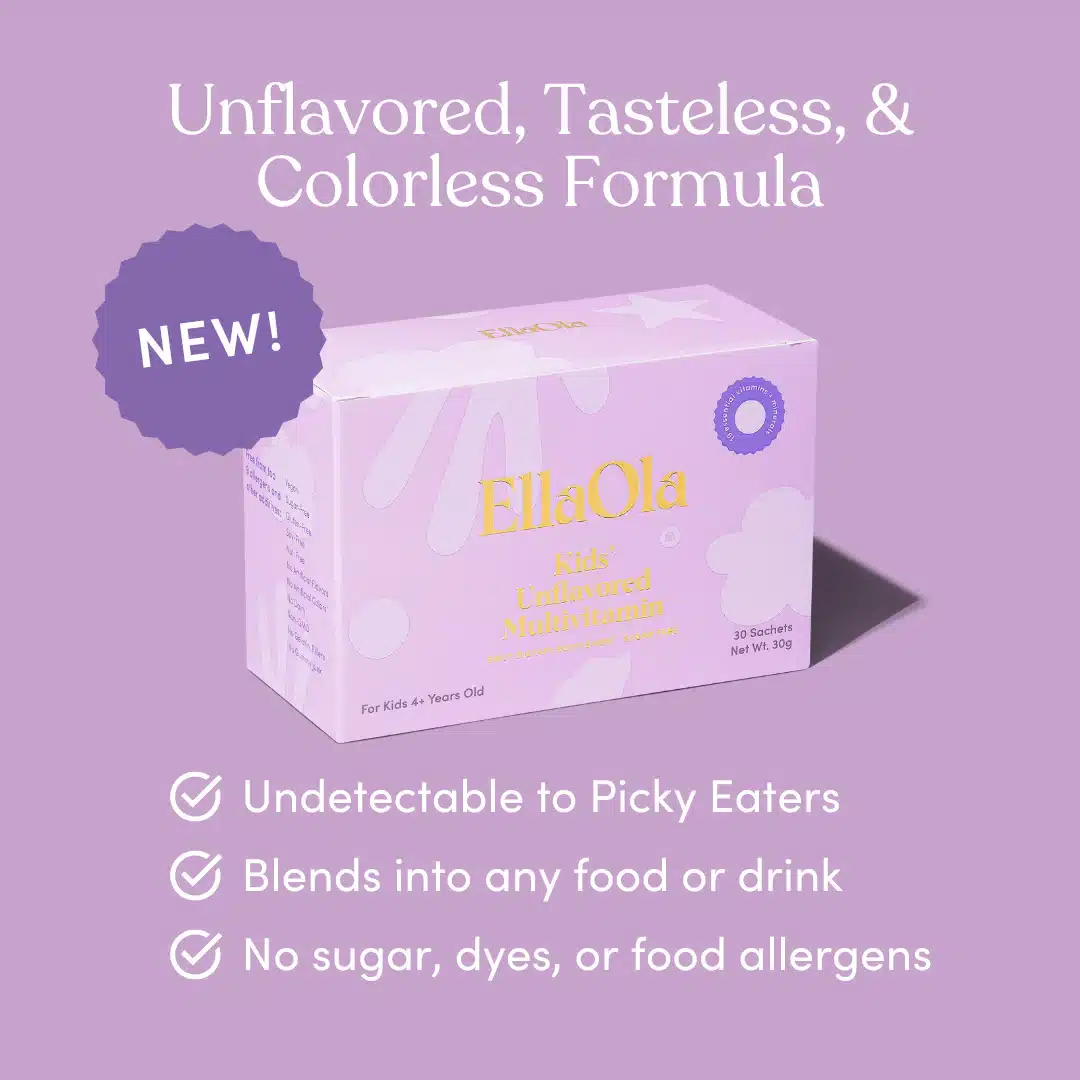
Photo by EllaOla
Best Kid’s Chewable Vitamin (With Iron)
- 18 key nutrients
- 13 nutrients meet RDA
- Sweetened with monk fruit, xylitol, mannitol
- Allergen free; dye free
- Third-Party Tested
- Suggested Dosage: 2 tablets for 4-8 year olds
- Product Reviews: Some parents report a chalky aftertaste or strong flavor. Renzo’s suggests crushing the tablet and mixing with juice for better acceptance. They also provide a money back guarantee for picky eaters who don’t tolerate it.
Seeking Health Kids Multivitamin
- 22 key nutrients
- 17 nutrients meet RDA
- Sweetened with xylitol and monk fruit
- Allergen free, dye free
- Third-Party Tested
- Suggested Dosage: 2 tablets for 4-8 year olds
- Considerations: This product is also available with methylated B vitamins depending on your child’s genetics and symptoms. This product also contains extra nutrients including boron and L-carnitine, which may be beneficial for children with extremely limited diets and children with ADHD.
- Product Reviews: Most parents report general acceptance of this vitamin.
Best Kid’s Chewable Vitamin (No Iron)
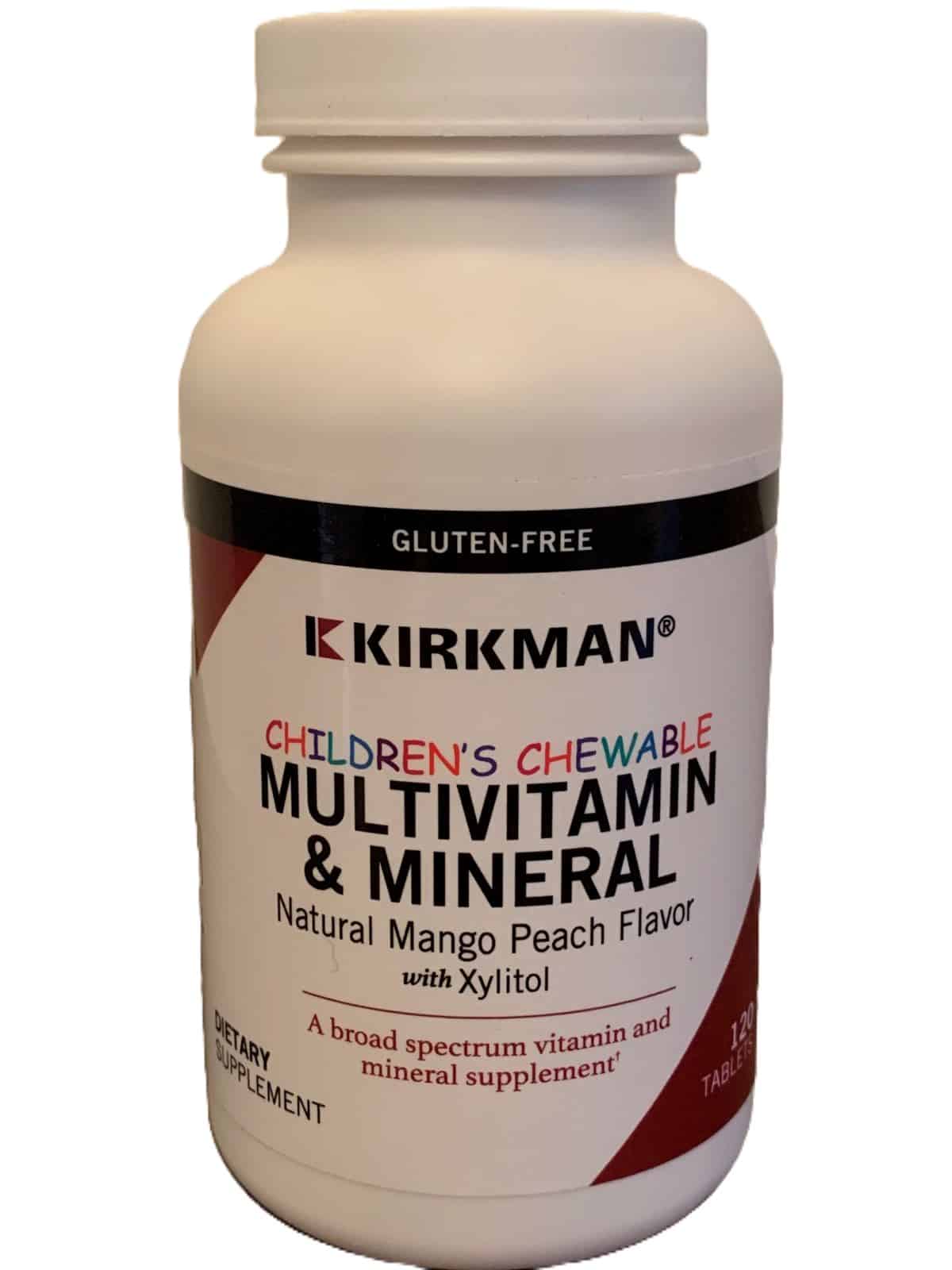
Kirkman Children’s Chewable Multivitamin & Mineral Tablets
- 21 key nutrients
- 13 nutrients meet RDA
- Sweetened with xylitol
- Allergen free, dye free
- Third-Party Tested
- Suggested Dosage: ½-1 tablet for 1-3 year olds, 1-1 ½ tablets for 4-8 year olds
- Considerations: This product is also available with methylated B vitamins depending on your child’s genetics and symptoms. This product contains a low amount of vitamin D, so your child may need an additional vitamin D supplement.
- Product Reviews: Most parents report general acceptance of this vitamin.
Best Kid’s Vitamin Capsule (With Iron)
Codeage Teen Fermented Multivitamin +
- 22 key nutrients
- 17 nutrients meet RDA
- Allergen free; dye free
- Third-Party Tested
- Suggested Dosage: 1-2 capsules ages 4-8 (mixed in liquid or with supervision/pill swallow cup), 2 capsules age 9+
- Considerations: This product contains high doses of some B vitamins which may not be suitable for all children. This product also contains a blend of enzymes and probiotics, which may cause digestive changes in some children.
- Product Reviews: Most parents report positive results with these products. A few parents report a strong smell/aftertaste from the capsule and/or digestive upset.
Best Kid’s Vitamin Capsule (No Iron)
Kirkman Children’s Multivitamin & Mineral Capsules
(same as chewable product information above)
Pure Encapsulations Junior Nutrients
- 22 key nutrients
- 16 nutrients meet RDA
- Allergen free; dye free
- Third-Party Tested
- Suggested Dosage: 1-2 capsules ages 4-8 (mixed in liquid or with supervision/ pill swallow cup), 2 capsules age 9+
- Considerations: This product contains high doses of some B vitamins, which may not be suitable for all children.
- Product Reviews: Parents appreciate the tiny size of the capsules. Some parents report a strong smell and/or aftertaste from the vitamins.
Best Kid’s Gummy Vitamin (With Sugar)*
*Because sugar sweetened gummy vitamins are the most prevalent option in retail stores, and because parents frequently ask about these, I included one option. However, I don’t personally recommend sugar-sweetened gummy vitamins to my clients.
Smarty Pants Kid’s Multi & Omega
- 14 key nutrients
- 8 nutrients meet RDA
- Sweetened with cane sugar, tapioca syrup
- Allergen free; dye free
- Third-Party Tested
- Suggested Dosage: 4 gummies ages 4+
- Considerations: Compared to non-gummy products, these have the lowest number of key nutrients and may not offer a noticeable difference for some children. Due to the sugar content, be sure to offer with a meal and to have your child brush their teeth afterwards. For children who are dentist averse, this is not a good option. There is a similar sugar-free (monk fruit) option available online.
- Product Reviews: Most parents report positive acceptance of the flavor and texture.
Best Kid’s Gummy Vitamin (No Sugar)
Nordic Naturals Zero Sugar Kid’s Multi
- 16 key nutrients
- 5 nutrients meet RDA
- Sweetened with xylitol
- Allergen free; dye free
- Third-Party Tested
- Suggested Dosage: 4 gummies ages 4+
- Considerations: Compared to non-gummy products, these have the lowest number of key nutrients and may not offer a noticeable difference for some children. This product contains a low amount of vitamin D, so your child may need an additional vitamin D supplement.
- Product Reviews: Most parents report good acceptance of this product. Some parents report a tart, grainy texture and mild digestive upset from the xylitol.
Vitamin Cautions
Once you’ve sorted through your options and decided on a vitamin supplement for your child, it’s important to keep the following cautions in mind!
- Age-Appropriate Dose-Many vitamins can be used for children of various ages, but ultimately your child’s age will determine the dosage. Vitamin labels generally specify age/dose differences, but if in doubt, ask your dietitian or healthcare provider.
- Gummies-Most children prefer gummies, but because they are sticky, I try to steer parents away from gummies with any added sugars (even naturally occurring ones like honey) to reduce the risk of cavities. Gummies can also make vitamins extra enticing, increasing the risk of accidental overdose.
- Mega Doses-Some vitamins contain very high amounts of B Vitamins, but keep in mind that more isn’t always better. Some children may experience adverse side effects to high doses of B vitamins, so always monitor your child’s reaction when starting a new supplement.
- Iron-Some children (especially those who eat a low animal protein diet) may have low iron stores. In these cases, it’s typically safe to offer a multivitamin that includes a low dose of iron (that doesn’t exceed the RDA), but note that in some kids, iron can cause constipation and digestive distress. Higher amounts of iron should never be given without proper testing. Children who regularly eat animal protein likely don’t need added iron.
- Storage-Most vitamin supplements are very safe for children in the proper dosage, but the main risk is accidental overdose. You’ve probably heard of “that kid” who scaled the countertops to get into the medicine cabinet. But you don’t want that to be your kid, so always store vitamin supplements tightly sealed, out of sight and reach from children.
Capping It Off (pun intended)
- While it’s most ideal for your child to “eat their nutrients,” many kids, especially chronically picky eaters, will need some type of vitamin/mineral supplement to fill in the gaps.
- Children who cut out entire food groups or have an extremely limited number of accepted foods tend to do best with a well-rounded multivitamin supplement. A dietitian can help to determine if any extras like omega-3s, choline, calcium, vitamin D, iron or magnesium are needed too.
- When choosing a vitamin for your child, it’s important to consider the total number and dosages of vitamins and minerals, added ingredients, safety and sourcing information, and the form that your child will best tolerate.
- Not all children will warm up to a new vitamin easily. You may need to enlist in some supportive tactics to increase acceptance. As with trying a new food, it may take 10+ tries before they will accept it.
- The “Top 10 List” above can save you some time from scouring labels. However, keep in mind that all products are slightly different, and that a product that works for your friend’s child is not guaranteed to work for yours.
- Vitamin and mineral supplements are generally safe and supportive nutrients, but as with any product that has a positive impact, there can occasionally be negative side effects too. Always monitor your child for new signs or symptoms when they are starting a new supplement.
- Lastly, vitamin/mineral overdosing (especially from iron) can be dangerous and even deadly. Always store vitamins tightly sealed and out of reach of children.
FAQ
Hiya vitamins tend to show up in the top of search engines for kid’s multivitamins. The main reason they don’t make my “Top 10” list is that they only have 16 total vitamins/minerals and only meet the RDA for 8 of them. They may be useful to fill in the gaps for some mildly picky eaters, but I wouldn’t recommend them for moderate to severe picky eaters. They tend to be comparable to most retail gummy vitamins.
Flintstones vitamins may be considered a nostalgic children’s vitamin icon, but with their current ingredients list, I do not recommend them for children. They do contain 17 vitamins and minerals and meet the RDA for 16 of them. However, they contain artificial colors, artificial sweeteners and trans fat, and I cannot safely recommend them.
Need More Help?
Choosing the right vitamin for your child can be confusing. If after reading this you’re still unsure where to start, Food to Table Nutrition offers 1:1 consultations for parents and their children.
This is not a substitute for medical advice. Please consult your healthcare provider prior to starting any new supplements with your child.
Food to Table Nutrition is not affiliated with any of these products or brands and does not make any profit from these recommendations.